“NARRATIVES ARE MADE OF PEOPLE”
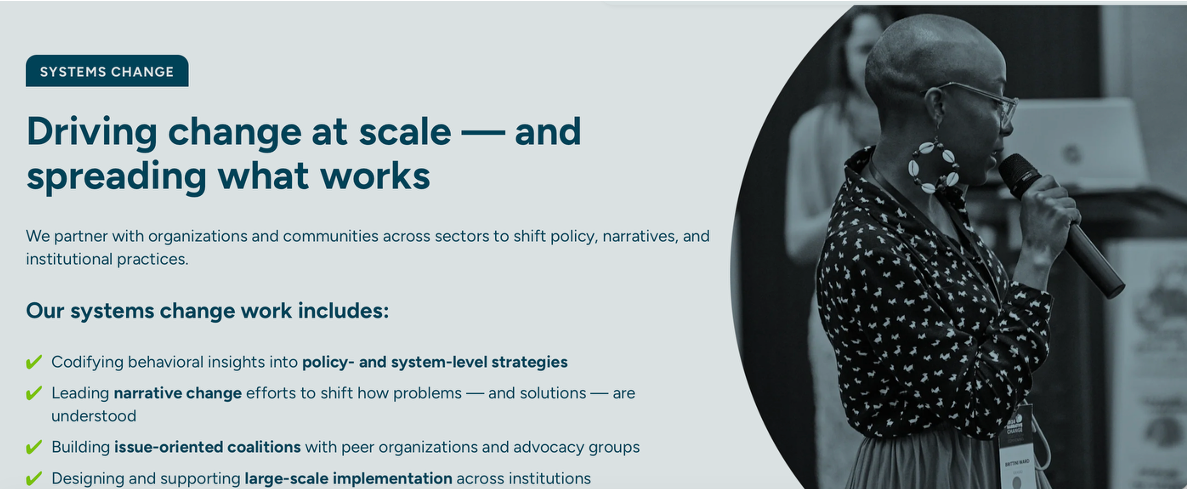
A screen capture of Brittini Ward presenting group reflections at a Narrative Change Coalition
Context Summary
Intended Audience: Nonprofit leaders, service providers, policymakers, community organizers, and practitioners interested in narrative change, systems change, and equitable public services.
Purpose: To reflect on lessons learned through narrative change work and explore how stories, systems, and human behavior intersect to shape public perception, institutional practices, and opportunities for social change.
My Role: Narrative Specialist and Community Coordinator with ideas42. I conducted qualitative interviews, engaged community stakeholders, synthesized research findings, contributed to the development of the Trusting Choice, Seeing Change intervention, and helped translate behavioral science concepts into community-centered narrative strategies.
Collaborators: ideas42 researchers and behavioral scientists, service providers, organizational leaders, community stakeholders, and individuals with lived experience whose interviews and participation informed the project's development.
Impact: This reflection emerged from a multi-year narrative change initiative focused on addressing harmful narratives within Detroit service systems. The work informed a narrative intervention that helped participants examine assumptions related to trust, choice, paternalism, and fatalism while encouraging more equitable and human-centered approaches to service delivery.
____________________
When I began working in narrative change, I assumed I would spend most of my time studying stories.
Instead, I spent most of my time studying people.
One of the most important lessons I learned through my work as a Narrative Specialist and Community Coordinator with ideas42 is that narratives are not abstract. They are not floating concepts that exist somewhere above us. Narratives are made of people. They are made of stories repeated often enough to feel like truth. They are made of experiences, rituals, assumptions, memories, policies, institutions, and behaviors. They are made of the countless ways human beings make meaning of the world around them.
And because narratives are made by people, they can also be changed by people.
This realization transformed how I think about social change.
Many of the dominant narratives shaping our society feel permanent. They become so familiar that we stop questioning them. We inherit them through schools, media, institutions, workplaces, and everyday interactions. We learn who belongs, who deserves help, who is responsible for their circumstances, and what is considered possible long before we consciously decide what we believe.
Yet during hundreds of interviews with service providers, organizational leaders, and people navigating public benefit systems, I discovered something surprising: many people were actively participating in systems they did not fully agree with.
The disconnect was everywhere.
Staff members often cared deeply about the communities they served, yet still carried assumptions about the people seeking assistance. Participants receiving services often internalized harmful beliefs about themselves despite possessing extraordinary resilience, resourcefulness, and determination. Organizational leaders wanted equitable outcomes while operating within systems built around outdated assumptions.
Everyone was responding to narratives that had existed long before they arrived.
One of the most persistent narratives we encountered was paternalism: the belief that people cannot make good decisions for themselves and therefore need others to make decisions on their behalf.
The other was fatalism: the belief that conditions are unlikely to improve and that meaningful change is beyond our control.
Neither narrative was usually spoken directly.
Instead, they appeared through policies, procedures, language, expectations, and everyday interactions.
They shaped who was trusted.
Who was believed.
Who was viewed as capable.
Who was seen as deserving.
What fascinated me was that many people holding these narratives considered themselves compassionate and well-intentioned. In many cases, they were.
The problem was not individual morality.
The problem was repetition.
When a narrative is reinforced often enough through institutions, media, and policy, it begins to feel natural. It becomes common sense. We stop recognizing it as a story and start experiencing it as reality.
This is where behavioral science and storytelling intersect.
Behavioral science helps us understand why people think, decide, and act the way they do.
Storytelling helps us understand why those behaviors matter.
Together, they reveal something powerful: changing systems requires changing the stories people believe about themselves and one another.
The intervention we developed, Trusting Choice, Seeing Change, was designed around this principle. Rather than beginning with policy, we began with personal narrative. Participants were invited to reflect on the stories they inherited, the assumptions they carried, and the experiences that shaped how they viewed others.
Because before people change systems, they often need language for understanding the stories that shaped them.
And before harmful narratives can be challenged, they first have to become visible.
What this work ultimately taught me is that systems are not fixed. They are built by people, maintained by people, and therefore capable of being changed by people.
The most powerful narrative shift is not convincing someone that a problem exists.
It is helping them imagine that something different is possible.
That is the work of narrative change.
And that work begins, as most meaningful stories do, with listening.
